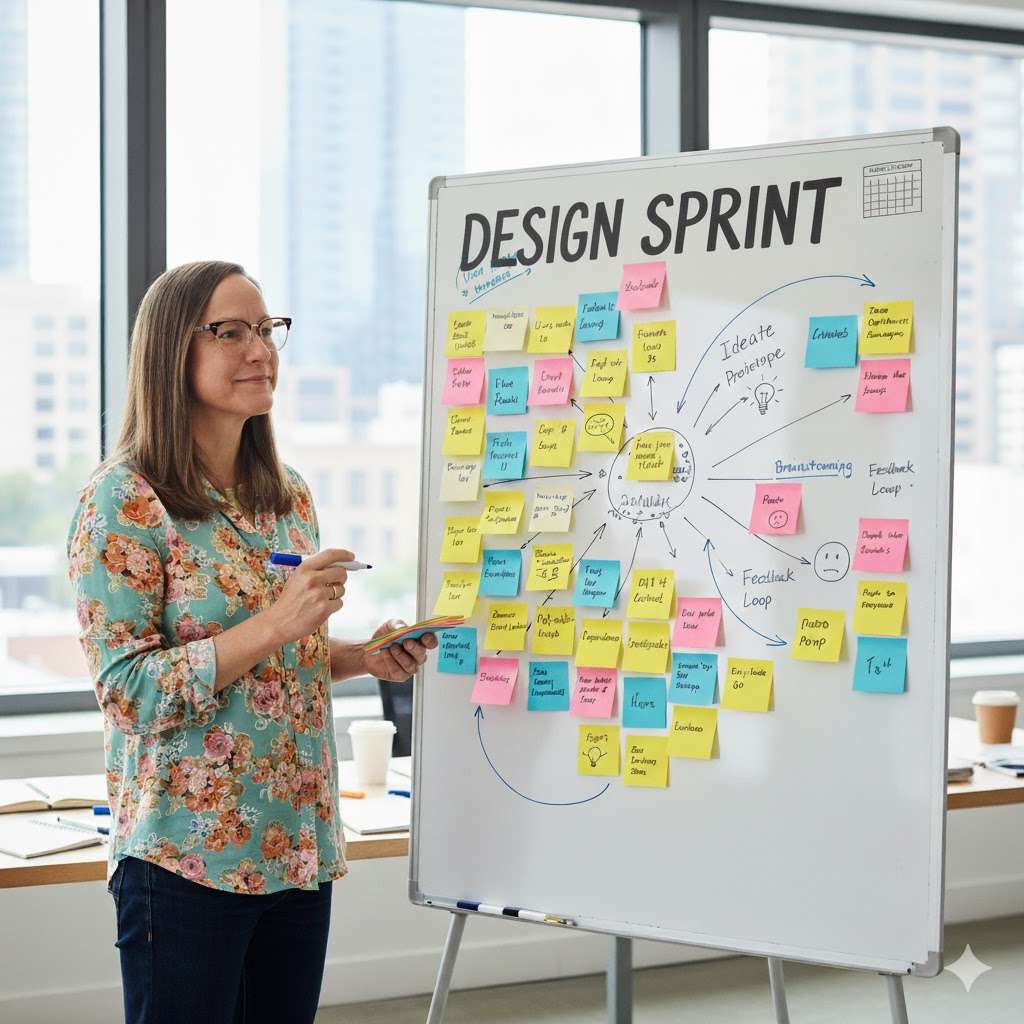
She’d spent fifteen years in HR. She knew the business, the people, and how to get things done.
When the CLO role opened up, she was the obvious choice. Six months in, there’s a feeling she can’t quite shake—a growing suspicion that the job is bigger than any one person’s career prepared them for.
Here’s the thing: she’s right.
The CLO role sits at the intersection of learning science, instructional design, technology architecture, business strategy, and organizational culture. Nobody’s career path covers all of it. This is where a fractional CLO can step in to co-pilot an organization’s L&D strategy
The HR veteran brings deep people systems knowledge and organizational savvy, but may feel less sure-footed in curriculum design. The instructional design expert brings rigorous learning architecture but may be newer to the C-suite and its particular demands. The technology leader brings platform fluency and data literacy, but may be less grounded in how adults actually learn. Every path to the CLO chair is also, by definition, a set of gaps.
The question isn’t whether you have blind spots. You do. The question is what you’re going to do about them.
Enter the Fractional CLO
Strategic Complement, Not Stopgap
A fractional CLO is a senior learning executive who works with an organization on a part-time, contract, or project basis, bringing deep expertise without the overhead of a full-time hire. The model has been common in finance (fractional CFO) and marketing (fractional CMO) for years. In learning and development, it’s catching up — and for good reason.
The problems it solves are real, and they show up in three distinct organizational scenarios.
Scenario 1: When Your CLO Needs a Thought Partner
The most overlooked use case for a fractional CLO isn’t about filling a vacancy. It’s about expanding the perspective of someone already in the role.
Think back to our HR-veteran CLO. She is not failing. She is doing what capable, intelligent people do when they step into roles that are bigger than their prior experience: figuring it out as she goes. But figuring it out alone is slow and, in the meantime, her organization is making decisions without the benefit of learning expertise she doesn’t yet have.
A fractional CLO brought in as a strategic thought partner changes that equation. The new CLO gets a colleague who has lived on the other side of the competency gap, someone who can execute the following goals:
- Pressure-test her thinking on curriculum design
- Speak the language of instructional systems with her vendors
- Help her build a measurement framework she can actually defend in the boardroom
This isn’t remediation. It’s the same reason a seasoned CEO uses an executive coach: not because something is broken, but because the best leaders are the ones who know what they don’t know and go get it.
The fractional engagement doesn’t have to be long. Six months of structured thought partnership can leave a CLO meaningfully more capable in the areas that once made her palms sweat. That’s a return on investment that’s hard to argue with.
Scenario 2: When Your CLO Needs a Second Chair
The second scenario is one sitting CLOs will recognize immediately: you have a major initiative on the horizon, and it is going to consume everything.
A merger. A large-scale digital transformation. A regulatory mandate requiring organization-wide retraining. The kind of project that doesn’t pause for your existing roadmap.
The kind that, if you’re honest, is going to crowd out the ordinary work of running the learning function for the next year or more.
When balancing these priorities, a CLO typically faces two limited options:
- Hire. But hiring takes time you don’t have, and a full-time employee is a long-term commitment for what is, at its core, a temporary surge.
- Ask your team to absorb the extra work. But you already know what that does to morale and quality.
A fractional CLO can step in as a skilled second chair: someone senior enough to take real ownership of a workstream, experienced enough to require minimal ramp time, and structurally designed to disengage cleanly when the work is done. They can lead the initiative while you hold the function, or hold the function while you lead the initiative. The division of labor is yours to design.
There’s an additional dividend worth naming: a good fractional CLO will often leave something behind. They might mentor a high-potential team member into a more senior role, document processes that previously lived only in people’s heads, or introduce frameworks your team will continue to use long after the engagement ends. The temporary relationship builds permanent capacity.
Scenario 3: When You Need to Build a Learning Strategy from Scratch
The third scenario belongs to a different kind of organization entirely: one that knows it needs a learning function but isn’t large enough, or yet sure enough, to justify a full-time CLO hire.
These organizations are often in a particular kind of pain. Learning is happening, but it’s fragmented. Different departments are doing their own thing. An LMS was purchased two years ago and nobody really owns it. Onboarding varies wildly by team. There’s no coherent learning strategy, just a collection of activities that accumulated over time.
A full-time CLO hire feels premature. But doing nothing feels increasingly untenable, especially as the organization grows and the fragmentation compounds.
A fractional CLO can come in at a fraction of the cost of a full-time executive, assess the landscape, build the infrastructure, and establish the governance that makes a future full-time hire possible and successful. They can help the organization figure out what it actually needs before it commits to a permanent role, a particular structure, or a specific set of tools.
Think of it as standing up the function before the function exists. By the time the organization is ready to hire a full-time CLO, there’s something real to hire into: a defined scope, a working strategy, and a team that already knows how to operate within it.
What to Look for in a Fractional CLO
Not all fractional engagements are created equal, and not all fractional CLOs are the same. A few key attributes are worth considering as you evaluate this operational model:
Depth over breadth: The value of a fractional CLO is in the expertise they bring to your specific gap. A generalist who has done a little of everything may be less useful than a specialist who has spent years solving the exact problem you’re facing. Be clear about what you need before you start the search.
Cultural and interpersonal fit: A fractional engagement is shorter than a full-time hire, but it still requires trust, candor, and the ability to work across organizational dynamics. The technical fit matters. So does the human one.
A clear scope and exit strategy: The best fractional engagements have a defined purpose and a defined end. What will be different when this engagement is over? What decisions will have been made, what capacity will have been built, what work will have been handed off? Getting clear on this at the start shapes everything that follows.
Willingness to transfer knowledge: A fractional CLO who builds dependency isn’t serving you well. Look for someone whose orientation is explicitly toward building your capacity, not extending their own engagement.
The Broader Picture for Your L&D Strategy
The rise of the fractional model in L&D reflects something larger happening in how organizations think about expertise and talent. The assumption that every critical capability needs to live inside a full-time employee is giving way to a more fluid model, one where senior expertise can be accessed precisely when and how it’s needed.
For CLOs, this is worth paying attention to in two key ways:
- As consumers of the model: You may find that a fractional engagement is exactly the tool you need to close an operational gap, weather an enterprise surge, or step up your overarching L&D strategy.
- As leaders: You may find that your own fractional availability is a way to extend your impact beyond a single organization, work across a portfolio of interesting problems, and build a body of experience that a single full-time role simply can’t offer.
The job has always been bigger than one person. The fractional CLO is one smart, practical answer to that fact.
If any of these three scenarios sounds familiar, you just might have a use case for a fractional CLO or other expert learning professional and thought partner. Reach out to explore the possibilities.