Face the data and grow into the future instead of resisting it.
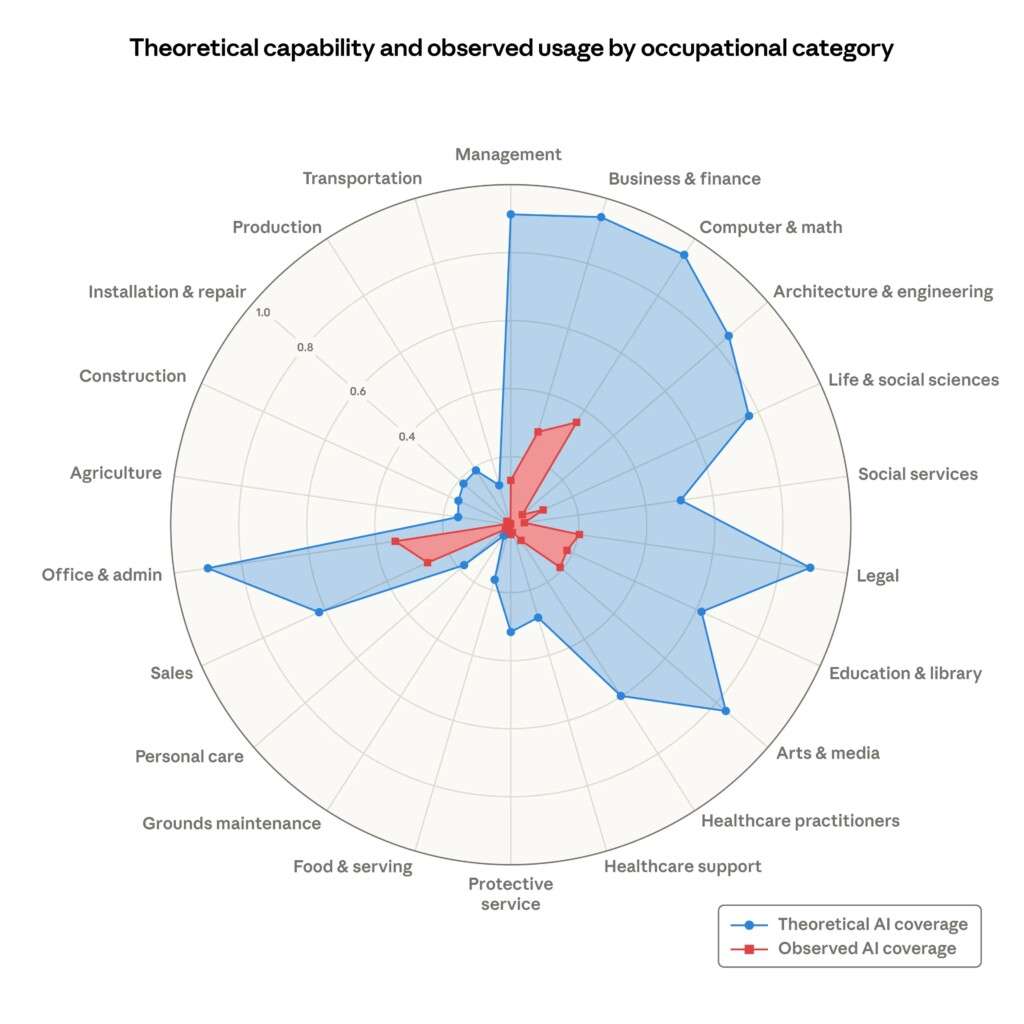
Anthropic just published a report* that maps which jobs AI is actually doing right now versus which ones it could do. The chart is sobering. Business and financial roles? AI could theoretically handle 85% of the tasks. It’s only doing about 20% right now.
That gap — between what AI can do and what it is doing — is closing. And it’s closing fast.
Here’s why I’m telling you this.
I’ve spent my career designing how people learn at work. I’ve built curricula, led learning teams, and won some awards I’m proud of. I know how adults change. I know how to build the thing that helps them get there.
And I’m looking at that chart thinking: a whole lot of what I do is in the blue zone.
So I have a choice. I can pretend the chart doesn’t apply to me. Or I can do what I’ve spent my whole career telling other people to do — learn, adapt, and grow into what’s next.
I’m choosing door number two.
Over the next several months, I’m going to be writing about what it looks like when a senior learning professional stares down the AI wave and decides to swim instead of stand on the shore. What I’m learning. Where I’m stumbling. What I’m figuring out about designing learning systems that work WITH AI instead of getting replaced by it.
Because here’s the thing I keep coming back to. I’m not a construction worker. I’m an architect. And a good architect doesn’t panic when someone invents a new building material. She learns what it can do, what it can’t do, and designs something better than what was possible before.
That’s the journey I’m on. And I have a feeling I’m not the only one.
If you’re a learning professional, an instructional designer, a CLO, a training leader — and you’re looking at the AI landscape thinking “where do I fit in this?” — come along. I don’t have all the answers yet. But I’m done pretending the questions don’t apply to me.
*You can see the report at www.anthropic.com/research/labor-market-impacts